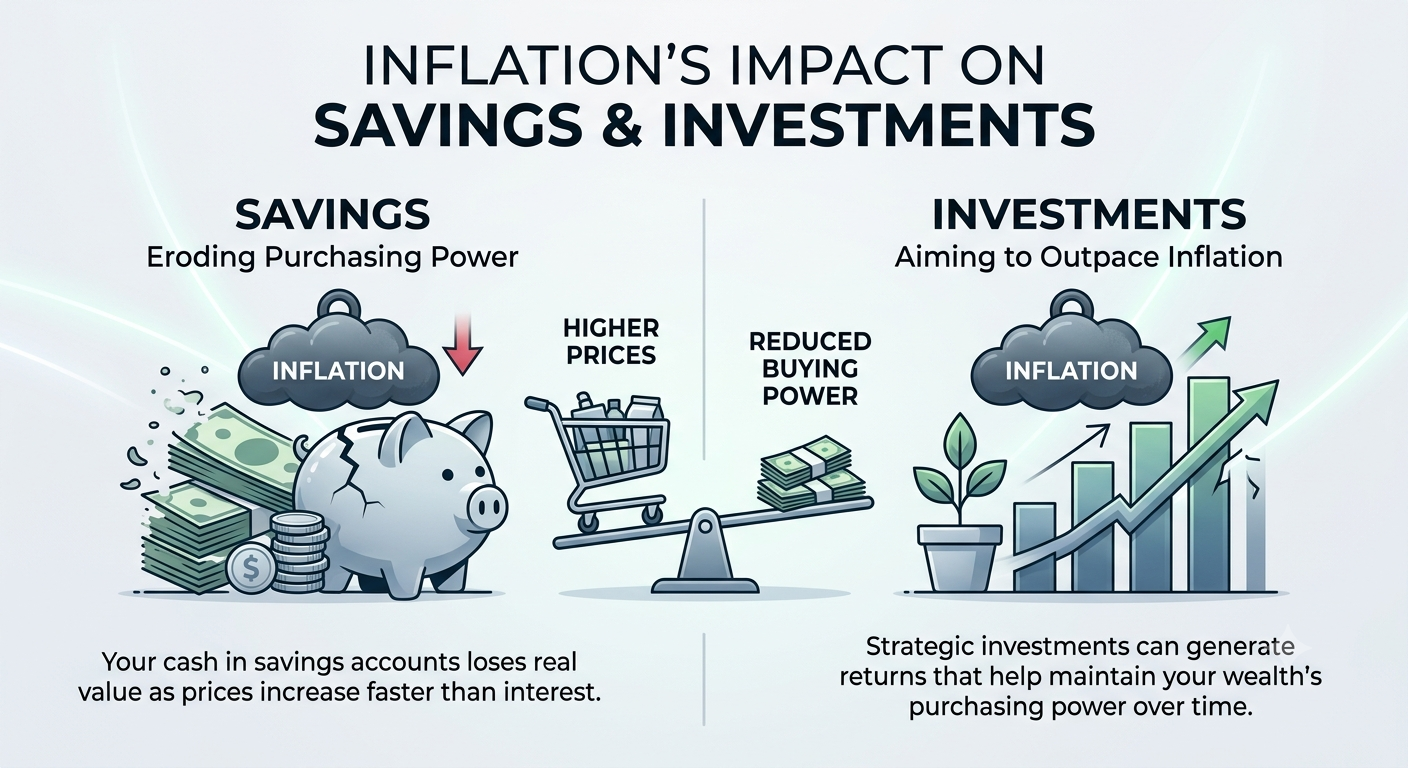
Inflation is something we hear about regularly, especially when the prices of groceries, fuel, education, healthcare, and everyday essentials start increasing. But inflation does more than make your monthly expenses expensive. It can also quietly reduce the value of your savings and affect the returns you earn from your investments.
For Indian households, understanding inflation is important because simply saving money is not always enough. You also need to think about how your money can retain its purchasing power over time.
What Is Inflation?
Inflation refers to the general increase in the prices of goods and services over a period of time. When inflation rises, the purchasing power of money falls.
For example, suppose ₹1,000 is enough to buy a particular set of household items today. If prices rise by 6% every year, you may need around ₹1,060 to buy the same items next year.
This is why inflation matters when planning for long-term financial goals such as buying a house, funding your child’s education, or building a retirement corpus.
How Inflation Affects Your Savings
One of the simplest ways to protect money is to keep it in a savings account or other low-risk saving options. However, the interest earned may not always keep pace with inflation.
Suppose your savings earn 4% interest in a year while inflation is 6%. On the surface, your bank balance has increased. But in real terms, your money has lost purchasing power.
This difference between the return you earn and the inflation rate is often called the real return.
A simple way to understand it is:
Real Return ≈ Investment Return − Inflation Rate
So, if your investment earns 8% and inflation is 6%, your approximate real return is 2%, before considering taxes and other costs.
This does not mean savings accounts are unnecessary. They are useful for maintaining an emergency fund and meeting short-term needs. The important point is to understand their purpose rather than expecting them to create significant long-term wealth.
Inflation and Fixed Deposits
Fixed deposits (FDs) are popular among Indian investors because they are relatively simple and provide predictable returns. However, inflation should be considered before judging whether an FD is suitable for a long-term goal.
For example, if an FD provides an annual interest rate of 7% and inflation is 5%, the approximate pre-tax real return is only 2%.
Taxes can reduce the effective return further, depending on your tax situation. Therefore, when comparing an FD with other investment options, it is useful to look at the post-tax return and compare it with inflation.
That said, FDs can still have an important role in a diversified financial plan, particularly for investors who prioritise capital stability and predictable returns.
How Inflation Affects Different Investments
Inflation does not affect every investment in the same way.
1. Equity Investments
Shares and equity mutual funds can potentially generate returns that outpace inflation over long periods. Companies may increase the prices of their products and services as their costs rise, although this varies significantly from company to company.
Equity investments, however, also carry market risk. Their value can rise and fall, particularly over shorter periods. Therefore, investors should consider their investment horizon and risk tolerance rather than investing only because they want to beat inflation.
2. Debt Investments
Bonds, debt mutual funds, and other fixed-income investments can provide relatively predictable income, depending on the product. But rising inflation can reduce the purchasing power of the income you receive.
For investors relying heavily on fixed-income investments, inflation risk becomes particularly important over long periods.
3. Gold
Gold is often considered a store of value and is commonly included in Indian investment portfolios. It may behave differently from financial assets during certain economic conditions.
However, gold prices can fluctuate and do not guarantee returns that will beat inflation every year. It is therefore better viewed as one possible component of a diversified portfolio rather than a complete solution to inflation.
4. Real Estate
Property prices and rental values may rise over time, potentially providing some protection against inflation. However, real estate also comes with costs such as maintenance, registration charges, taxes, and transaction expenses.
Property is also relatively illiquid compared with financial investments, meaning it may take time to convert it into cash.
Inflation and Your Financial Goals
Inflation becomes especially important when your financial goal is several years away.
Imagine you want to build ₹50 lakh for a future goal. If the cost of that goal rises by inflation over the years, ₹50 lakh may not have the same purchasing power when you actually need it.
This is why financial planning should consider the future cost of a goal, rather than simply its cost today.
For example, parents planning for a child’s higher education should consider how education costs may increase over time. Similarly, retirement planning should account for rising healthcare and living expenses.
How Can You Protect Your Money From Inflation?
There is no single investment that can eliminate inflation risk. Instead, investors can consider a diversified approach based on their goals, time horizon, and risk profile.
Keep sufficient money in liquid and low-risk options for emergencies and short-term expenses. For medium- and long-term goals, consider investments that have the potential to generate returns above inflation over the relevant period.
Regular investing can also help. A systematic investment approach allows you to invest consistently instead of depending entirely on market timing.
Most importantly, review your investments periodically. If your income, expenses, goals, or time horizon change, your financial plan may need to change as well.
Final Thoughts
Inflation may look like a small percentage on paper, but its impact can become significant over many years. The money you save today needs to retain enough purchasing power to meet your future needs.
For Indian investors, the key is not simply to ask, “How much return will I earn?” It is also important to ask, “How much will that return be worth after inflation and taxes?”
By keeping an emergency fund, understanding real returns, diversifying investments, and planning for the future cost of financial goals, you can make more informed decisions about your money.
Inflation cannot be completely avoided, but with proper planning, you can prepare your savings and investments to deal with its long-term impact.