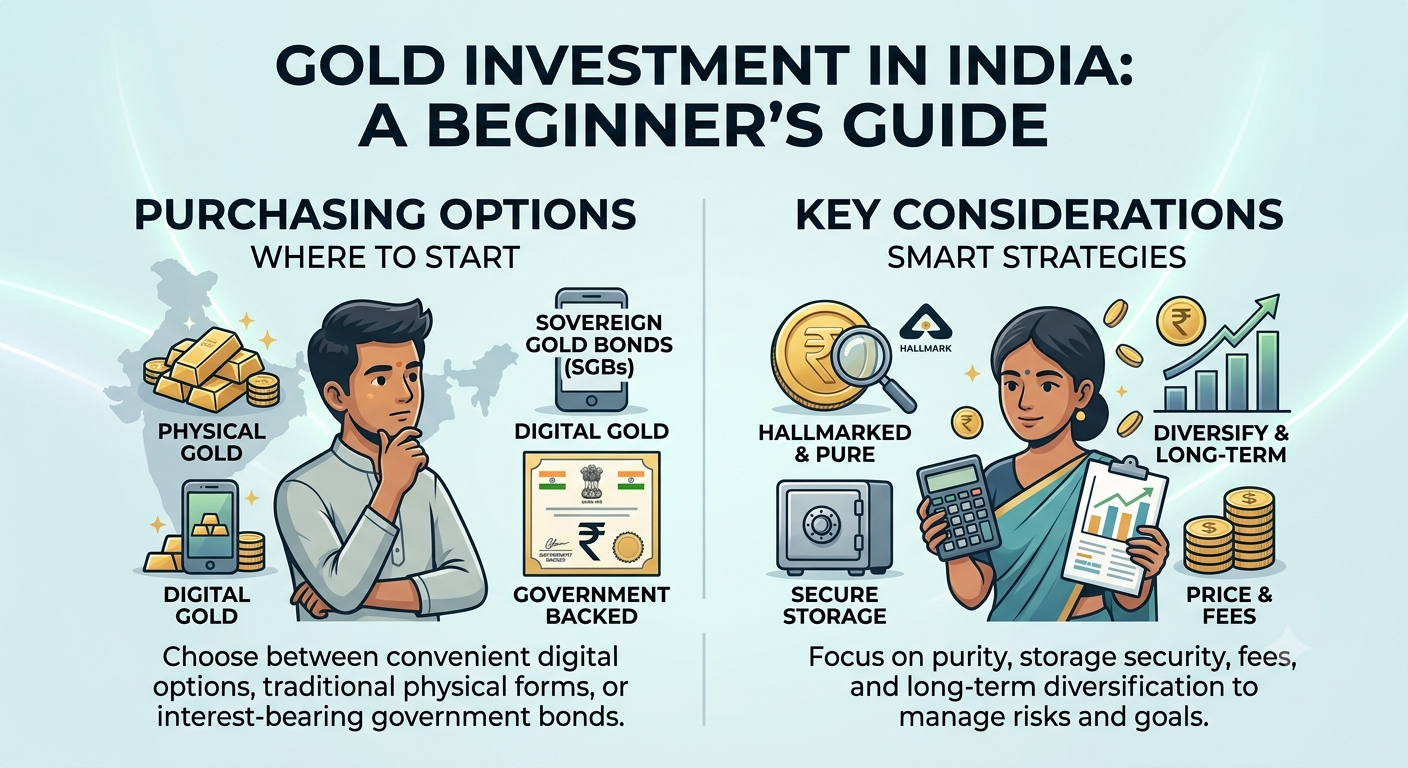
Gold has always held a special place in Indian households. From jewellery received during weddings to gold coins purchased during festivals, gold is closely connected with Indian traditions and wealth. But today, gold is not only something people buy for personal use. It has also become a popular investment option.
For beginners, however, investing in gold can seem confusing. Should you buy physical gold, gold ETFs, or digital gold? How much of your savings should go into gold? And what factors affect gold prices?
This guide explains the basics of gold investment in India in a simple and practical way.
Why Do Indians Invest in Gold?
Gold is often considered a store of value. Unlike many financial assets, it has been valued for centuries across different economies and cultures.
One reason investors consider gold is diversification. Gold prices do not always move in the same direction as equity markets or other investments. Therefore, having some exposure to gold may help diversify an investment portfolio.
Gold is also highly liquid compared with many physical assets. Depending on the form of gold you own, it can generally be sold when you need funds.
However, gold prices can rise and fall. It is not a guaranteed-return investment, and investors should understand the risks before investing.
Different Ways to Invest in Gold in India
Beginners have several options when it comes to gold investment.
1. Physical Gold
The traditional method is buying gold jewellery, coins, or bars.
Jewellery is often purchased for personal use as well as wealth accumulation. However, from a pure investment perspective, jewellery has additional costs such as making charges and, depending on the product and transaction, other applicable charges.
Gold coins and bars can be more straightforward for investment purposes, but buyers should pay attention to purity, certification, pricing, and storage.
Physical gold also needs to be stored securely. Keeping substantial quantities at home may create security concerns, while bank lockers involve additional costs.
2. Gold ETFs
Gold Exchange Traded Funds, commonly known as Gold ETFs, are market-linked investment products designed to provide exposure to gold prices.
They can be bought and sold through a demat and trading account during market hours. This means investors do not have to physically store gold.
Gold ETFs may be useful for investors who want gold exposure without purchasing jewellery or physical bars. However, they involve expenses and market-related considerations, so investors should read the scheme information before investing.
3. Gold Mutual Funds
Gold mutual funds typically invest in Gold ETFs or other gold-related instruments. They can be accessed through mutual fund platforms and generally do not require a demat account.
For beginners who are already familiar with mutual funds, this can be another way to gain exposure to gold.
As with other mutual funds, investors should check the fund’s objective, expenses, risks, and historical performance rather than selecting a fund based only on recent returns.
4. Digital Gold
Digital gold allows individuals to purchase small quantities of gold online. The purchased gold is represented digitally and is generally backed by physical gold held by a provider or custodian.
It is convenient because investors can start with relatively small amounts. However, beginners should carefully check the provider, applicable charges, storage arrangements, redemption terms, and regulatory framework before investing.
Convenience should not be the only factor when choosing an investment product.
What Determines Gold Prices?
Gold prices in India are influenced by several factors.
International gold prices are an important influence because gold is traded globally. Currency movements also matter because India imports a significant portion of its gold requirements.
Other factors can include interest rates, inflation expectations, global economic conditions, central-bank activity, investor demand, and geopolitical uncertainty.
This is why gold prices can change even when there is no major change in India’s domestic economy.
How Much Gold Should a Beginner Buy?
There is no single percentage that is suitable for every investor.
Your allocation should depend on factors such as your income, financial goals, emergency fund, existing investments, investment horizon, and risk tolerance.
For many investors, gold may be considered as one part of a diversified portfolio rather than the entire portfolio. Putting all your savings into gold can expose you to concentration risk.
Before investing, it is sensible to first build an emergency fund and address high-cost debt.
Gold Investment vs Gold Jewellery
This is an important distinction for beginners.
Jewellery can have emotional and cultural value, particularly for weddings and festivals. But investment returns should be considered separately from the enjoyment or utility of wearing jewellery.
When buying jewellery, making charges and other costs can affect the effective investment value. The price you pay and the amount you eventually receive when selling the item may therefore be quite different.
If your primary objective is investment rather than personal use, financial gold products or standardised physical gold may be worth comparing with jewellery.
Taxation and Other Costs
Gold investments can have tax implications in India, and the rules can differ depending on the type of gold investment and how long you hold it. Taxes and regulations can also change over time.
Investors should therefore check the latest rules applicable to their specific investment before making a decision.
Also consider costs such as brokerage, fund expenses, buying and selling spreads, making charges, storage costs, and applicable taxes. These expenses can affect your actual returns.
Common Mistakes Beginners Should Avoid
A few common mistakes can make gold investing more expensive or risky than expected:
- Buying jewellery solely because gold prices are rising.
- Investing all savings in gold.
- Ignoring purity and documentation when buying physical gold.
- Choosing a product without understanding its charges.
- Making decisions based only on short-term price movements.
- Forgetting about taxation and selling costs.
- Treating gold as a guaranteed-return investment.
Final Thoughts
Gold can play a useful role in an investment portfolio, but it should be approached with the same discipline as any other investment. Beginners should understand the different forms of gold investment, compare their costs and risks, and consider how gold fits into their broader financial goals.
Whether you choose physical gold, Gold ETFs, gold mutual funds, or another option, the key is to invest with a clear purpose rather than simply following market trends.
For Indian investors, gold can be more than a traditional asset it can also be one component of a diversified long-term financial strategy.